Plesfeda
— WBS Board
A board for building real Work Breakdown Structures.
Breakdown first, schedule later.
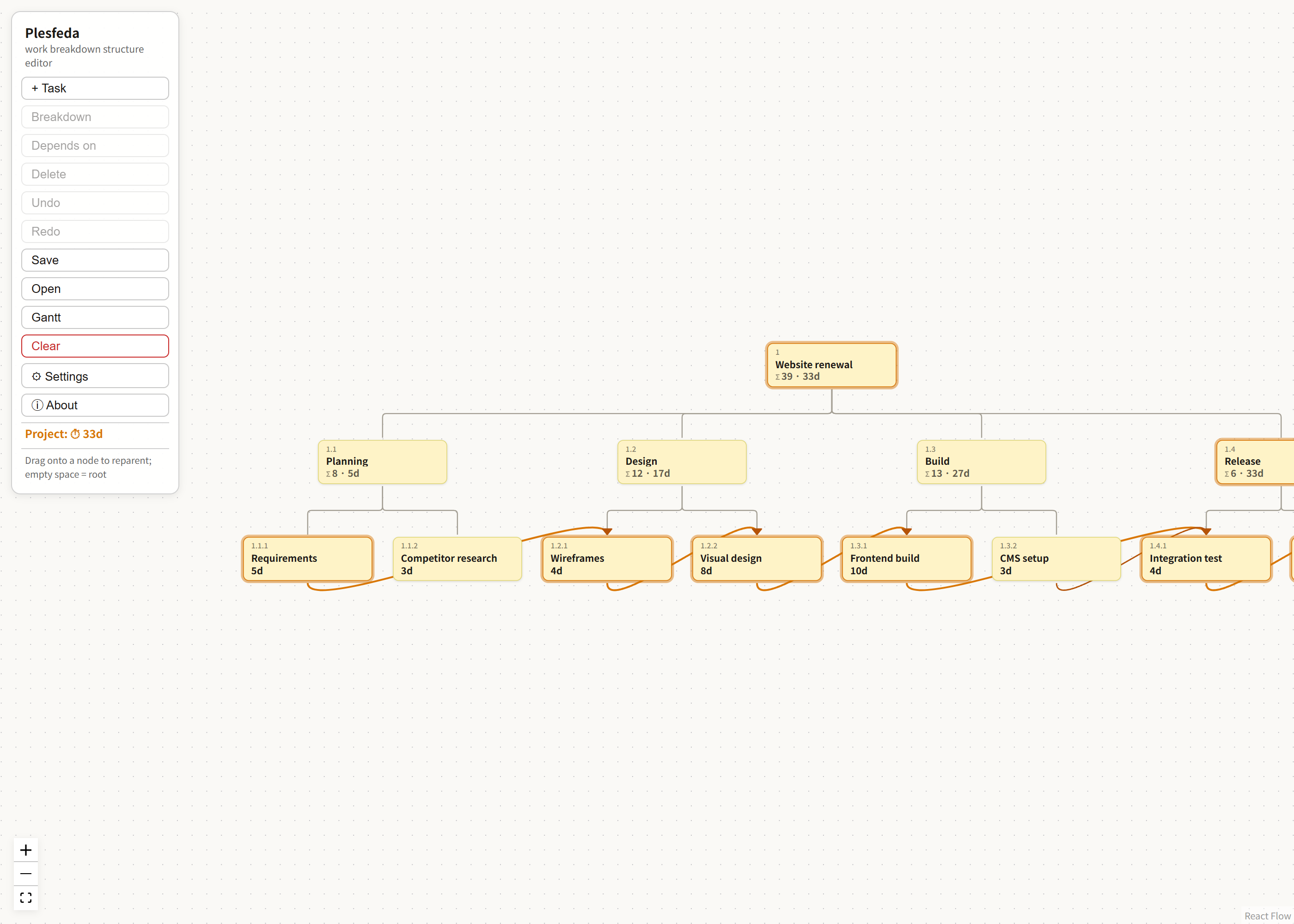
Most "WBS tools" are actually Gantt editors
Most tools sold as "WBS tools" are really Gantt chart editors. Lining up rows and dragging dates is useful, but it doesn't help you build what a WBS actually is: a structure of decomposed work.
Heavyweight PM tools — MS Project, OpenProj, LibrePlan and friends — let you move rows, but never let you pick up a block of work and hang it somewhere else in the structure. And their calendars don't even ship with your local holidays, so estimates always end up back in Excel. Plesfeda exists to scratch exactly those itches.
Plesfeda is not a project management tool. It is a tool for calmly judging whether a given volume of work can fit inside a deadline. The protagonists are breakdown and hierarchy — dependencies, scheduling, and the Gantt chart are all derived output, never the input surface.
Type decompositions as you think them
Place a task on the board and choose breakdown — two dotted slots appear. The first is an active input with the cursor ready; the second is a ghost, a placeholder for the next entry. Every Enter promotes the ghost and grows a new one, so children stack up at the same tempo as your thinking.
Walk away mid-entry and the active slot falls back to a ghost at the parent's tail — click it to resume. Ghosts never persist into data until confirmed.
- Reparent whole subtrees Drop a node onto another and the whole branch follows; drop it on empty space and it becomes a root. You can even add a parent later and adopt existing roots — true bottom-up structuring. Cycles are always rejected
-
Derived WBS numbers
1.2.3-style numbering is computed from position. Reparenting and reordering renumber automatically — nothing is stored - Effort rollup Leaves take hand-entered effort; parents show the recursive subtree total (Σ), so a root tells you the cost of the whole structure at a glance
- Deleting a parent is a choice Promote its children to independent roots, or delete the whole subtree — you decide each time
The structure becomes a schedule
Tasks can declare predecessors (finish-to-start). A leaf's earliest start is simply the later of its parent's start and its predecessors' finishes — one rule, and the PERT/CPM forward pass returns the whole structure's earliest completion. The toolbar always shows the project's earliest finish, and the critical path is highlighted on nodes and dependency edges.
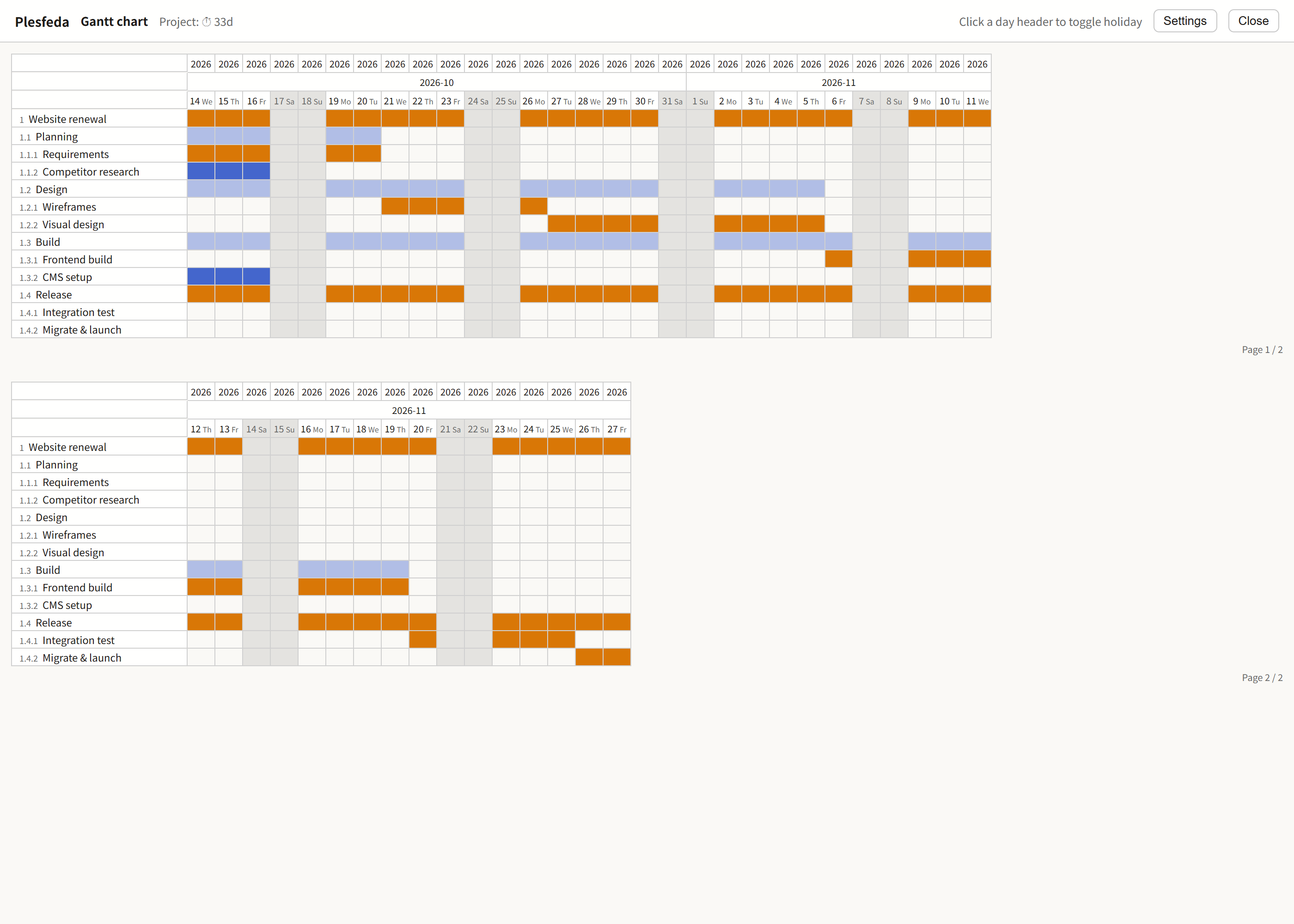
The Gantt is a read-only report generated from the tree — weekend/holiday-aware calendar, critical path (orange), milestones (◆)
Dependency cycles and ancestor/descendant dependencies are flagged as errors, and the Gantt stays locked until they're resolved — so a broken structure can't quietly produce a plausible-looking schedule.
Printing splits the chart across two-dimensional pages with repeated headers and page numbers, so it comes out as a real report. Click a day header to toggle a holiday, and choose days or hours as the effort unit.
About the name
Plesfeda combines Welsh pleth ("weave / braid") with Old Irish feda ("woods" — also the name of the letters of Ogham, the lost Celtic script whose characters are named after trees).
A structure woven from trees — which is exactly what building a WBS is.
Design choices
- Local-only Data lives in your browser's localStorage and JSON files. No account, no cloud, nothing is uploaded anywhere
- The Gantt is read-only — by design You don't nudge dates to make a schedule look right; you fix the structure and watch the schedule follow. That's the whole point of the tool
Give it a try and tell us how you'd like to use it.
Source code
Published under the MIT license. Built with React Flow + Vite + TypeScript.